Now Reading: Array vs Linked List: Which One Should You Use and When?
- 01
Array vs Linked List: Which One Should You Use and When?
Array vs Linked List: Which One Should You Use and When?


Written by Hamza Sanaulla
Array vs Linked List: Which One Should You Use and When? Imagine you are planning a massive dinner party. You have two options for seating your guests. The first option is to reserve a single, long banquet table where every seat is bolted down next to each other in a flawless row. The second option is to scatter smaller, independent tables throughout a bustling restaurant, giving each guest a slip of paper with the exact table number of the next friend in line.
If a new guest arrives at your long banquet table, you have to awkwardly force half the room to stand up and slide over one seat just to squeeze them in. But finding someone’s seat? Effortless. You know exactly where the fifth seat is instantly. On the flip side, the scattered tables make it incredibly easy to add new people anywhere in the room, but finding the eighth person requires you to walk from table to table, following the paper trail.
In software engineering, this is the exact operational trade-off you make when choosing between an array data structure and a linked list data structure. Both are foundational, linear data structures used for data organization, yet they manage your system’s RAM through completely opposing philosophies.
Whether you are designing a high-throughput backend service, optimizing a mobile app’s memory footprint, or going through rigorous programming interview preparation, choosing the wrong structure can introduce devastating bottlenecks. Let’s look at the underlying mechanics of both storage types, analyze their performance metrics under Big O notation, and establish a clear, data-driven decision framework.

What Is an Array?
An array is the absolute bedrock of modern digital storage. It represents a collection of elements, typically of the same data type, maintained in a strict, unbroken sequence.
Definition of an Array
In computer science, an array is a linear structure characterized by its static, homogeneous nature. When you declare an array, you are telling your compiler to claim a fixed block of real estate inside your machine’s physical hardware. This is known as static memory allocation. Because every element inside this structure shares the same byte footprint (e.g., a standard 4-byte integer or an 8-byte pointer), the collection remains highly predictable and uniform.

How Arrays Store Data
The defining magic of an array lies in contiguous memory. When your script initializes an array of five integers, the operating system finds an uninterrupted, sequential block of memory addresses to house them.
Because the elements sit shoulder-to-shoulder, the computer doesn’t need to search for where the next item lives. It relies on a process called indexing in an array. The system uses a simple mathematical base offset equation to resolve locations instantly:
Address= {Base Address} + (Inde x Element Size)
If your base address starts at 1000 and you want index 3 of a 4-byte integer array, the hardware instantly calculates $1000 + (3 X 4) = 1012. This bypasses any need to skim or scan through previous entries.
Advantages of Arrays
- Instantaneous Random Access: Thanks to the index math formula above, arrays are the ultimate random access mechanism. Your code can jump straight to the 1st, 500th, or 10,000th element in identical time.
- Exceptional Read Speeds: Element lookup is instantaneous, clocking in at an unbeaten $O(1)$ time complexity.
- Minimal Hardware Overhead: Arrays are incredibly lean. If you store 1,000 integers, your memory footprint consists almost entirely of those 1,000 integers. There are no hidden structural metadata fees or auxiliary tracking bytes.
Disadvantages of Arrays
- Rigid Sizing Limits: Traditional arrays suffer from strict array sizing limitations. You must declare your maximum capacity at compile time. If your data grows unexpectedly, you run into an out-of-bounds error.
- The High Cost of Resizing: To break past a size limit, your language runtime must allocate an entirely new, larger array elsewhere in memory and painstakingly copy every single original element over. For example, languages like Python abstract this with dynamic arrays (lists), but the performance penalty still triggers under the hood during a resize. You can learn more about how Python manages these sequences via the Official Python Data Structures Documentation.
- Expensive Insertions and Deletions: If you need to drop a new value into index 0 of an array containing a million elements, you cannot simply slot it in. Your CPU must perform a massive data migration, shifting the remaining 999,999 entries down by one slot in memory to clear space.

What Is a Linked List?
A linked list throws out the requirement for physical proximity entirely. Instead of forcing data to sit together in a single block, it scatters elements fluidly across whatever open spaces exist in your system’s RAM.
Definition of a Linked List
A linked list is a node-based data structure. Instead of existing as a monolithic container, it operates as a decentralized chain of independent units called nodes. A standard node splits its responsibilities into two distinct fields: the raw data payload itself, and one or more memory references known as pointers in a linked list. These pointers act as directional signposts, holding the exact hardware memory address of the next node in the sequence.

How Linked Lists Store Data
Linked lists use dynamic memory allocation, reserving resources on the system heap dynamically at runtime. This creates a highly fragmented, non-contiguous memory footprint. Node A might live at memory address 1042, while Node B sits far away at address 5098.
The chain remains intact because Node A explicitly stores the address 5098 inside its pointer property. The sequence begins at a designated memory tracker called the Head and concludes when a node’s pointer references Null, indicating that the end of the chain has been reached.
Depending on your structural needs, you can deploy a Singly Linked List (unidirectional pointers), a Doubly Linked List (nodes point both forward and backward), or a Circular Linked List (the final node points directly back to the head).
Advantages of Linked Lists
- Infinite Size Flexibility: The standout feature of a linked list is its dynamic sizing advantage. You never have to predict how many elements your application will hold. As long as your system has a single scrap of free RAM left on the heap, you can spin up a new node and link it to the chain.
- Lightning-Fast Modifications: Performing an insertion and deletion within a linked list is incredibly cheap. If you want to insert a node between two existing items, no elements are forced to move. Your code simply tells the prior node to update its pointer to the new item’s address, and sets the new item’s pointer to the next address. This is a pure $O(1)$ pointer swap.
Disadvantages of Linked Lists
- Forced Sequential Access: Linked lists completely lack indexing. If you need to read the data inside the 50th node, you cannot jump straight to it. Your code is forced to perform a step-by-step traversal in a linked list, starting at the head node and manually chasing pointers down the chain until you hit your destination.
- Slow Element Search Performance: Because you cannot use binary search variations efficiently on scattered pointers, standard searching algorithms on a linked list degrade into a slow, brute-force linear sweep.
- Noticeable Memory Overhead: Linked lists are far less memory efficient than arrays. On top of your data payload, every single node must pay a pointer tax. On modern 64-bit architectures, a single pointer requires 8 bytes of storage. If you are saving small data pieces like 4-byte integers, you are wasting twice as much memory on structural pointers as you are on your actual data.

Array vs Linked List: Key Differences
To truly understand the difference between an array and a linked list, we need to step away from abstract code structures and examine how these choices impact physical computer hardware.
Memory Allocation
Arrays rely on compile-time static memory allocation (or single block allocations on the heap for dynamic variants), reserving a dense, uniform partition up front. Linked lists rely entirely on run-time dynamic memory allocation, spinning up miniature node containers across the heap completely on the fly.
Data Access Speed
The structural layout dictates your data lookup latency. Arrays read data with instant, mathematical precision. Linked lists are bound to sequential access, which scales linearly with the size of your collection.
Insertion and Deletion Performance
Modifying data presents an inverse performance trade-off:
- Arrays require heavy memory shifts ($O(n)$ time) to maintain their strict contiguous layout during an interior edit.
- Linked lists update references instantly ($O(1)$ time) through quick pointer updates, completely avoiding any data rearrangement.

Memory Usage
When evaluating array vs linked list memory usage, think of it as structural density. Arrays have zero structural bloat but risk wasting space if you over-allocate a massive fixed container that sits half-empty. Linked lists maintain a perfectly scaled payload with zero empty slots, but pay a persistent, heavy pointer memory tax on every single item they hold.
Cache Performance
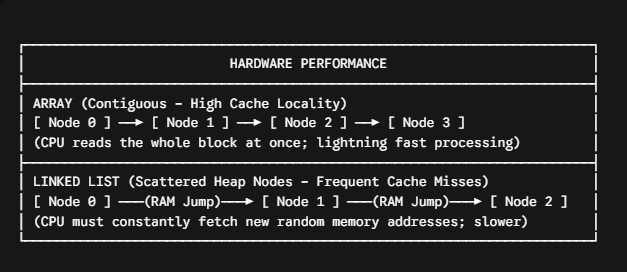
This is where arrays hold a massive, often hidden advantage in production environments. Modern CPUs utilize an optimized optimization strategy called spatial locality. When a CPU pulls an item from an array into its ultra-fast L1/L2 cache lines, it automatically grabs the next few consecutive elements along with it, predicting you will need them next.
Because linked list nodes are scattered randomly across the system heap, they cannot take advantage of this hardware shortcut. This results in frequent, costly cache misses that slow down execution velocities by forcing the CPU to repeatedly wait on the slower primary RAM.
Implementation Complexity
Arrays are incredibly simple to manage and are natively supported by almost every language’s syntax with standard bracket notation (matrix[i]). Linked lists introduce significant code complexity. Developers must explicitly manage nested pointer assignments, deal with edge cases like clearing empty lists, and protect against memory leaks or null-pointer exceptions.
Time Complexity Comparison
Let’s look at the theoretical performance profiles of both data models. When reviewing array vs linked list performance, these classic Big O notation metrics serve as an essential engineering reference:
| Algorithmic Operation | Array Data Structure | Linked List Data Structure |
| Random Access / Lookup | $O(1)$ (Constant Time) | $O(n)$ (Linear Time) |
| Search (Unsorted Data) | $O(n)$ (Linear Time) | $O(n)$ (Linear Time) |
| Search (Sorted Data) | $O(\log n)$ (via Binary Search) | $O(n)$ (Forced Linear Sweep) |
| Insertion (At Beginning) | $O(n)$ (Forced Element Shifts) | $O(1)$ (Instant Pointer Swap) |
| Insertion (At End) | $O(1)$ (Amortized for Dynamic) | $O(1)$ (If Tail Pointer exists) |
| Insertion (In Middle) | $O(n)$ (Forced Element Shifts) | $O(1)$ (Excludes traversal time) |
| Deletion (At Beginning) | $O(n)$ (Forced Element Shifts) | $O(1)$ (Instant Pointer Swap) |
| Deletion (In Middle) | $O(n)$ (Forced Element Shifts) | $O(1)$ (Excludes traversal time) |

When Should You Use an Array?
An array is your default choice for storage. You should lean toward it unless specific application constraints explicitly force your hand.
Best Use Cases for Arrays
Arrays excel when your target dataset size is predictable, or when your application relies heavily on read operations rather than mutations. If your codebase runs mathematical computations, handles dense sorting routines, or values a low, tight memory footprint, the array is your optimal path.
Real-World Examples of Arrays
- Digital Image Processing: A digital image display buffer is structured as a multi-dimensional array of pixel values, where instant random access is required to render graphics correctly.
- Database Record Storage: Database engines store row indices in contiguous blocks to minimize read latency when executing lookups.
- Everyday Application States: Storing fixed configuration settings, static dropdown options, or an established list of calendar months.

When Should You Use a Linked List?
Linked lists should be deployed intentionally when data volumes fluctuate unpredictably and writing data takes priority over reading it.
Best Use Cases for Linked Lists
A linked list is the best data structure for dynamic data systems where data volumes scale completely unpredictably. If your architecture requires elements to be continuously queued, inserted, or purged from the beginning or middle of a collection without triggering massive cascading memory shifts, choose a linked list.
Real-World Examples of Linked Lists
- Media Player Playlists: Music apps use doubly linked lists to power track queues, allowing you to cycle smoothly between the Next and Previous tracks via pointer navigation.
- Web Browser History Trees: Navigating backward and forward through your browser tabs utilizes a pointer-tracking system to manage your history trail.
- Foundational System Containers: Building execution models for alternative structures like a Stack, Queue, or Hash Table bucket chains where items enter and exit continuously.
Intent-Driven Guide: Choosing Your Blueprint for Technical Interviews and Real-World Scale
When engineers weigh data structure trade-offs, the ideal solution often depends on whether they are solving an interview puzzle or optimizing a live cloud service.
Interview vs. Production Decision-Making Matrix
In entry-level technical interviews, candidates are often taught that linked lists are flat-out superior for insertions because they boast a clean $O(1)$ time complexity mark. However, in modern production architectures, this advantage is often a mirage.
Before you can insert a node into the middle of a linked list, you must first spend $O(n)$ time running a linear search to locate that specific spot. Unless you are modifying data explicitly at the head pointer, the initial traversal time can completely wipe out any performance gains from the fast pointer swap.

Performance vs. Maintenance Overhead Comparison
When choosing your collection types for real-world projects, keep these operational factors in mind:
- Garbage Collection Pressure: In managed runtimes like Java, Go, or Python, creating millions of independent node objects adds immense stress to the Garbage Collector. Purging millions of scattered pointers can cause noticeable latency spikes, whereas an array can be cleared from memory in a single sweep.
- Concurrency and Thread Safety: Arrays are vastly easier to safely read across multiple threads because their memory bounds are completely fixed. Editing pointer references across multi-threaded linked lists requires complex node-locking patterns to prevent race conditions or segmentation faults.
If you want to pass tough coding assessments, check out structured problem-solving tracks on Exercism’s Computer Science Paths or deep-dive articles on Real Python to build algorithmic intuition.

Common Mistakes When Choosing Data Structures
Even experienced software engineers can fall into subtle traps during system design. Let’s look at two common optimization mistakes.
Choosing Arrays for Frequent Insertions
A common mistake is using a standard array to process live, streaming data feeds. If your application continuously injects records into the front of a list, an array will force your CPU to repeatedly move huge blocks of memory, severely degrading your application’s responsiveness.
Choosing Linked Lists for Random Access
Conversely, selecting a linked list for a system that relies on random lookups or binary searching algorithms is a recipe for lag. Forcing your code to step through thousands of pointers just to retrieve a single record creates an unnecessary linear bottleneck that completely neutralizes your CPU’s processing power.

Which Data Structure Is Better?
The definitive answer to which is better: array or linked list? is simple: neither is universally superior. They are distinct engineering blueprints optimized for entirely different problems.
Choose an Array If…
- You know the exact number of elements in your collection ahead of time.
- Your application’s primary task is looking up data via random access.
- You need optimal execution speeds and want to leverage hardware CPU cache locality.
- Memory capacity is constrained, and you cannot afford pointer byte overhead.
Choose a Linked List If…
- Your data volume scales completely unpredictably.
- Your application prioritizes rapid-fire insertions and deletions over lookups.
- You are building a foundational streaming utility like a stack or queue.
- You don’t need to perform binary search routines across your collection.

Quick Summary / Key Takeaways
- Arrays are contiguous blocks that excel at high-speed lookups ($O(1)$) but scale poorly ($O(n)$) when modifying interior elements.
- Linked lists are decentralized chains that offer infinite flexibility for size updates and fast modifications ($O(1)$), but require a slow linear walk ($O(n)$) to read values deep within the list.
- Hardware architecture matters: Arrays take full advantage of CPU caching mechanisms, whereas linked lists incur an extra pointer memory tax on every single node you create.

Frequently Asked Questions (FAQs)
Is an array faster than a linked list?
Yes, arrays are vastly faster for accessing and searching data due to direct indexing and excellent CPU cache alignment. However, linked lists are faster at adding or removing elements because they don’t require shifting data in memory.
Why are linked lists slower for searching?
Linked lists lack indexing entirely. To find a value, your application cannot use fast lookup math or binary search options; it must start at the head node and manually check every element one by one.
Can a linked list replace an array?
Conceptually, yes, both store linear data sequences. However, substituting one for the other without considering your application’s access patterns can introduce massive performance drops due to their completely different space-time complexities.
Which data structure is more memory efficient?
Arrays are generally more memory-efficient because they store pure data without any structural overhead. Linked lists require you to store reference pointers alongside your data, which can easily double the memory footprint for smaller data types.
Conclusion
At the end of the day, mastering computer science foundations isn’t about memorizing code snippets; it’s about understanding architectural trade-offs. Choosing between an array and a linked list requires balancing your memory budget against your application’s data patterns.
If you are looking to master these paradigms across specific languages, checking out the GeeksforGeeks Data Structures Guide or enrolling in a targeted university track can help anchor these concepts.
The best way to lock in this knowledge is to build something yourself. Try writing both structures from scratch in your preferred language today to see how they manage data firsthand!
Related Blogs
What is DSA? Why Every Programmer Must Learn Data Structures and Algorithms
Time Complexity and Big O Notation Explained Like You’re 10 Years Old
Arrays in Data Structures: Complete Guide with Real-Life Examples
2D Arrays (Matrices) Explained: How to Store and Access Data
Singly Linked List: Insertion, Deletion, and Traversal Complete Guide