Now Reading: Time Complexity and Big O Notation Explained Like You’re 10 Years Old
- 01
Time Complexity and Big O Notation Explained Like You’re 10 Years Old
Time Complexity and Big O Notation Explained Like You’re 10 Years Old


Written by Hamza Sanaulla
Time Complexity and Big O Notation Explained Like You’re 10 Years Old. If you want to understand how software engineers measure code efficiency without using a stopwatch, the answer lies in mastering time complexity and Big O notation. To grasp how this works, use a simple real-world puzzle: imagine you want to share a massive collection of funny dog videos with your best friend who lives across town. You have two options. You could upload them to a cloud drive or copy them to a physical USB drive, then hop on your bicycle and pedal over to their house.
Which way is faster?
If you only have one small video, uploading it takes a few seconds. The internet wins easily. But what if you have ten terabytes of high-definition footage? Uploading that much data could take days over a standard home connection. On the other hand, riding your bicycle across town takes exactly 20 minutes, whether you are carrying a single video clip or a backpack jammed full of multi-terabyte storage drives.
In the world of coding, this is the exact foundation of running time analysis. It is not about measuring time with a stopwatch; it is about figuring out how a task slows down as it gets bigger. When you start exploring a simple coding concept’s explanation, you quickly realize that code performance changes completely depending on the scale of your data. This foundational concept belongs to the most essential beginner computer science topics every aspiring developer must master.
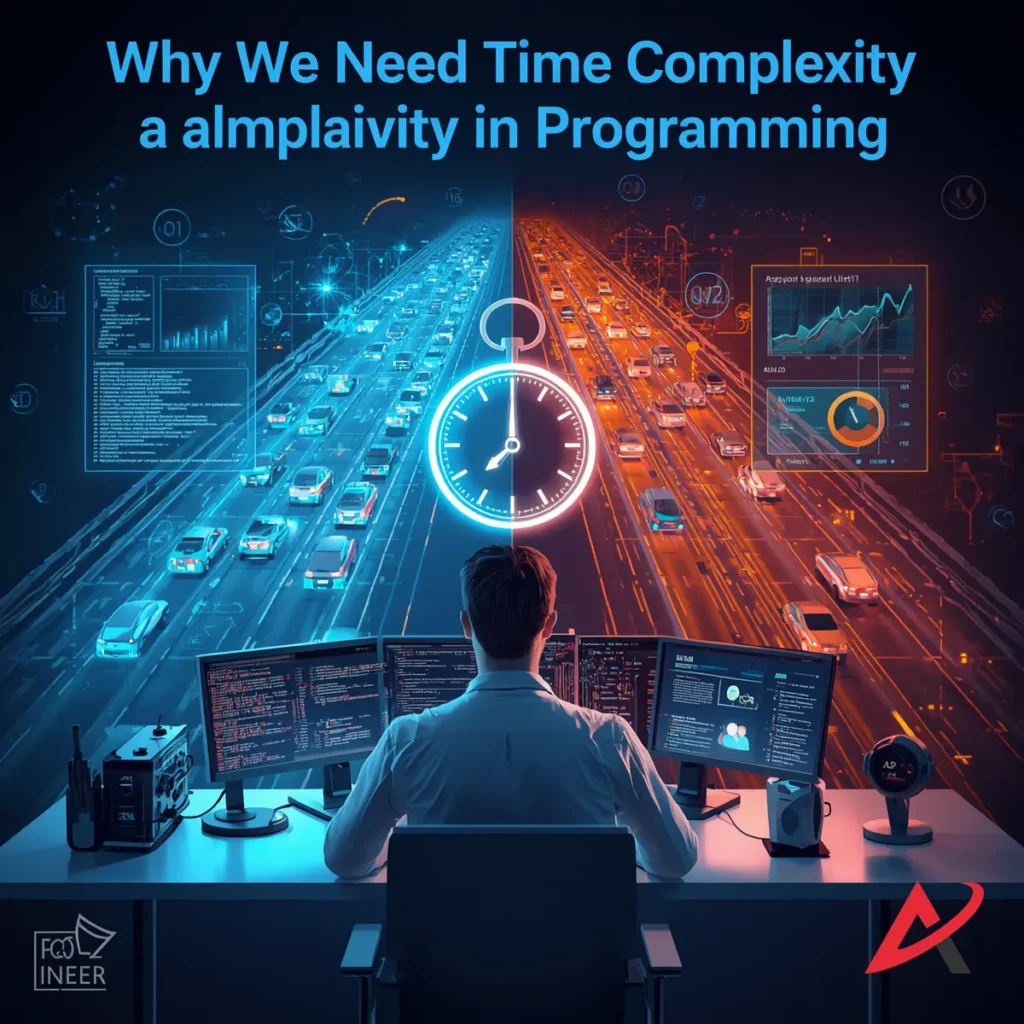
Why We Need Time Complexity in Programming
A common trap for new programmers is thinking that code speed is determined entirely by how fast a computer’s processor ticks. You might write a script, run it on a modern gaming computer, and watch it finish in a fraction of a millisecond. You might assume your work is flawless. But what happens when that same script runs on an old, inexpensive smartphone? Or inside a tiny smart-home thermostat?
This is the hardware trap. If we measured the efficiency of code purely in minutes and seconds, a poorly written program on a supercomputer would look “better” than a masterfully optimized program running on an ancient laptop. We need a universal metric that is independent of hardware.
That metric is what we call time complexity. So, what is time complexity in programming? It is a mathematical framework that tracks how the number of operational steps within a piece of code scales with the size of the input data.
To see this in action, let’s consider the concept of a scaling explosion. If you write an application that handles ten user profiles, almost any messy approach will work instantly. But if your user base suddenly jumps to ten million, an inefficient approach can trap your servers in an infinite loop of calculations, causing an expensive crash. Understanding algorithm efficiency ensures that you build systems capable of surviving real-world pressure. When we study computational complexity, we learn to look past our local machines and predict exactly how software will behave in production environments.
What is Big O Notation and How Do We Define It?
To keep track of these scaling behaviors without getting bogged down in messy math, computer scientists use a standard notation called Big O notation. You can think of Big O as a universal scoreboard that grades how well an algorithm scales.
The name itself sounds intimidating, but it is actually a big O notation explained simply. The letter O stands for Order of growth. Right next to the O, you will see parentheses containing a mathematical variable, usually the letter $n$. The variable $n$ represents the total number of items your code has to process. It could be the number of names in a phone book, the number of products in an online store, or the number of pixels in an image.
When you learn to understand Big O notation easily, you realize it acts as an equalizer in core coding knowledge. It skips the trivial variations between programming languages, ignores minor hardware discrepancies, and cuts straight to the core architecture of an algorithm. It answers one fundamental question: As the size of the data ($n$) approaches infinity, how violently does the workload grow?
How Big O Notation Works Step-by-Step
When analyzing code, Big O does not count every single microscopic operation. It does not care if a computer spends a microsecond allocating memory for a variable or updating a UI label. Instead, it looks for the single dominant factor that dictates growth.
For example, if a script performs $2n + 5$ steps, a mathematician might want to keep every digit. A software engineer using Big O throws away the constant multiplier (the 2) and the flat addition (the 5), simplifying the entire expression down to $O(n)$. Why? Because when $n$ scales from ten items to ten billion items, multiplying by two or adding five becomes completely irrelevant to the overall system load. We only care about the driving force of the growth curve.

Worst Case, Best Case, and Average Case
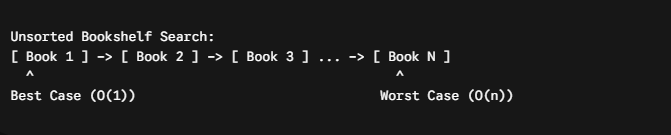
Imagine you are looking for a specific book on a messy, unorganized shelf containing 50 novels. You start checking them one by one from left to right.
- Best Case Complexity: You walk up to the shelf, pull out the very first book on the left, and it happens to be the exact book you wanted. You found it in a single step.
- Average Case Complexity: On average, you will probably find your book somewhere around the middle of the shelf, taking roughly 25 checks.
- Worst Case Complexity: The book you want is located at the absolute furthest end on the right, or it isn’t on the shelf at all. You have to inspect all 50 books.
When performing algorithm analysis, programmers focus almost exclusively on the worst-case complexity. As veteran systems architect Dr. Evelyn Vance often remarks:Bad code runs beautifully when your test database has three rows. It is the fourth million that breaks your system. Always architect your code for the worst-case scenario, because out in the real world, the worst-case scenario happens every single day.
By preparing for the absolute worst-case outcome, you establish a reliable performance guarantee. We also analyze best-case complexity and average-case complexity during deep data structures performance analysis to see how code acts under normal conditions, but Big O notation explicitly measures the worst-case ceiling. It teaches you how the system behaves when the universe is actively working against your server resources.
Common Types of Big O Notation Complexity Profiles
Different approaches to a single problem produce wildly divergent paths. Let’s look at the standard Big O profiles you will find when studying software development, ranked from the absolute fastest to the most dangerous.
O(1) Constant Time
This is the ultimate gold standard of performance. An $O(1)$ algorithm takes the same number of steps regardless of how much data you throw at it.
- The Analogy: Think of a physical light switch on a wall. It takes the same amount of effort to flip the switch if you are the only person in the room or if a million people are standing outside in the hallway. The size of the crowd changes nothing about the action.
- Code Example: Checking if a specific number is odd or even, or pulling the first element out of an array containing ten billion values. The time required is immediate and completely flat.
O(log n) Logarithmic Time
Logarithmic time is incredibly fast and represents highly optimized searching mechanics. Every time the algorithm takes a step, it slices the remaining data pool completely in half.
- The Analogy: Imagine I ask you to guess a number between 1 and 100, and I will tell you if your guess is too high or too low. If you guess 50, you instantly eliminate half of all possible numbers in one single turn. If I say too high, you instantly know the answer is between 1 and 49. You repeat this chopping process until you find the target.
- Code Example: This is known as Binary Search. It is a fundamental tool for anyone trying to learn coding basics because it allows computers to scan through millions of sorted records in fewer than thirty total steps.

O(n) Linear Time
With linear time, your resource costs grow in a perfectly straight line alongside your data. If your dataset doubles in size, your execution time doubles right along with it.
- The Analogy: Imagine you have a box of unorganized, tangled holiday lights, and you need to look at each individual bulb to find the one that is burnt out. If the strand has 10 bulbs, you make 10 checks. If it has 10,000 bulbs, you must make 10,000 checks.
- Code Example: A standard
forloop that reads through a collection from start to finish looking for a matching item. It serves as an essential benchmark in any foundational programming guide.
O(n log n) Efficient Sorting Time
This complexity profile represents a hybrid approach. It combines the structural elegance of splitting problems in half ($O(\log n)$) with the necessity of scanning across the data layer ($O(n)$).
- The Analogy: Suppose you are given ten separate decks of playing cards that have been completely scrambled together. To organize them, you split the giant pile into smaller, manageable sub-piles, sort those smaller units individually, and then cleanly merge them back together in perfect sequence.
- Code Example: This is the standard speed limit for intelligent, modern sorting utilities like Merge Sort, Quick Sort, and Timsort.
O(n²) Quadratic Time
Now we are moving into dangerous territory. Quadratic time means performance degrades drastically with even minor increases in data size. If your dataset doubles, your execution time quadruples. If your data grows by a factor of 10, your workload skyrockets by a factor of 100.
- The Analogy: Imagine a classroom filled with students. If every single student in the room is required to walk around and shake hands with every other individual student in the class, the total number of handshakes explodes dramatically with every new student who walks through the door.
- Code Example: This typically happens when you write a nested loop, meaning you place a loop inside another loop. The system checks every element against every other element in the collection. Identifying these bottlenecks is the first critical phase of aggressive code optimization.

O(2ⁿ) Exponential Time
This is the ultimate nightmare scenario for software performance. The execution time doubles with every single additional item added to your dataset.
- The Analogy: Think of the classic ancient story about the inventor of chess. He asked the king for a single grain of rice on the first square of a chessboard, two on the second, four on the third, eight on the fourth, doubling each time. By the time you reach the 64th square, the amount of rice required could cover the entire planet.
- Code Example: Trying to find a hidden password by brute-forcing every single possible alphanumeric character combination, or solving the classic Travelling Salesperson Problem using a basic recursive search.
Real Life Examples of Big O
To separate these ideas from raw code syntax, let’s look at how these algorithmic profiles govern human actions in the real world.

Looking Up a Word in a Printed Dictionary
If you want to find the definition of the word Quantum in a massive printed book, you would never use an $O(n)$ strategy by reading the book line-by-line starting on page one. Instead, you utilize the fact that the book is sorted alphabetically. You flip open the book directly to the middle. If you see words starting with the letter M, you know Q must be in the right-hand half. You completely disregard the left half of the book and repeat the split. By using an $O(\log n)$ approach, you locate a single term out of hundreds of thousands of words in a matter of seconds.

Cleaning a Scrambled Playroom
Imagine a floor covered completely in hundreds of mixed Lego bricks, wooden blocks, and action figures. If a parent picks up an individual piece, walks all the way to the toy chest to drop it off, walks back, and picks up the next piece, they are working in $O(n)$ time.
However, if they choose to sort the items first by grouping every Lego brick, then comparing each toy to every other item to match them up into explicit thematic play sets before putting them away, they risk sliding into an $O(n^2)$ time sink. Suddenly, a simple cleaning chore takes all afternoon because the organizational step required comparing every toy to every other toy.

Why Big O Matters in Programming
If you ignore time complexity, your application will eventually break. A system that feels incredibly fast during internal development can drop to its knees the moment real-world network traffic surges. Understanding how your algorithms behave at scale allows you to write resilient, future-proof code.
Beyond keeping systems online, writing optimized code is critical for your professional trajectory. Engineering departments at premier global tech companies use these specific parameters to evaluate technical competence. If you cannot explain the performance profile of the code you write, it becomes incredibly difficult to pass a professional engineering assessment.

The Roadmap to Mastering Algorithms
Transitioning from a high-level conceptual understanding to practical code execution requires an intentional, step-by-step learning path.
[ Understand Concepts ] ➔ [ Download Cheat Sheets ] ➔ [ Take Structured Courses ] ➔ [ Practice Problems Online ]
To help you move efficiently from a beginner level to advanced technical mastery, consider leveraging these structured steps:
- Consolidate Reference Material: Start by finding clean visual aids. You can check out our printable algorithm cheat sheet references online to keep a clear, at-a-glance guide to performance curves right on your desktop while you write code.
- Engage in Interactive Training: If you thrive with step-by-step video guidance, look into a dedicated Big O notation video course or look for highly rated programming tutorials for beginners that emphasize structural optimization.
- Study Core Structures: To understand how data layout changes performance, consider enrolling in a comprehensive data structures course or browsing top-tier university curricula. For career changers, a great path is to find a dedicated bootcamp or join community coding tracks to learn programming step by step.
- Daily Implementation Practice: Theory is useless without regular execution. Make it a habit to practice algorithm problems online on platforms like LeetCode, CodeWars, or HackerRank to internalize the fundamentals of coding interview basics and advanced system design.
Quick Summary / Key Takeaways
To lock these foundational insights into place, remember these simple rules whenever you evaluate software performance:
- Ditch the Stopwatch: Time complexity is calculated by counting operational steps relative to data size ($n$), not by measuring hardware processing seconds.
- Plan for the Worst: Big O notation prioritizes worst-case complexity to give you a definitive performance floor when things go wrong.
- The Speed Spectrum: Keep your code as close to flat lines ($O(1)$ and $O(\log n)$) as possible. Be incredibly careful with nested operations ($O(n^2)$) or doubling operations ($O(2^n)$), which can lock up your infrastructure.
| Big O Notation | Operational Speed | Data Scale Impact | Real-World Equivalent |
| $O(1)$ | Constant | Perfectly Flat | Flipping a wall switch |
| $O(\log n)$ | Logarithmic | Extremely Slow Growth | Flipping open a dictionary |
| $O(n)$ | Linear | Steady, Predictable Growth | Checking a string of holiday lights |
| $O(n \log n)$ | Linear-Logarithmic | Moderate, Manageable Growth | Organizing and sorting a card deck |
| $O(n^2)$ | Quadratic | Heavy, Dangerous Growth | A classroom full of handshakes |
| $O(2^n)$ | Exponential | System-Crashing Explosion | Rice grains doubling on a chessboard |

Final Thoughts
Transitioning into a skilled developer requires a major mental shift. You must move beyond simply writing code that works and focus on writing code that scales.
The next time you sit down to write a function or design a loop, pause to review your architecture. Look closely at how your data moves through the loops. Ask yourself: What is the Big O score of this code? What happens to my server if $n$ becomes a million? Once you begin evaluating your work through the lens of structural scaling, you stop writing simple scripts and start engineering real software systems.
Related Blogs
What is DSA? Why Every Programmer Must Learn Data Structures and Algorithms